



Tying Pheasant Tails
by Shilo Mathill
Winters in the Rockies can often be long. My favorite streams and rivers are under a blanket of ice and being hypnotized by a bobber at the local tailwaters is not the relief I’m looking for. It is that time of year when more hours are spent thinking about and preparing for fishing than actually getting out and wetting a line. Time is spent sorting through flies, fixing leaky waders, browsing catalogs for the latest gadgets, and reorganizing the gear I have amassed over the years – how did I manage to acquire six nets anyway? Much of my time is also spent at the tying desk - cranking out the flies I know are going to catch fish next season and tweaking a few for fun of it.
As I go through my list and inventory my bugs, there is one fly I can never have enough of - the pheasant tail nymph. The pheasant tail was developed in England by Avon River Keeper Frank Sawyer. Sawyer’s Pheasant Tail (P.T.) used only natural cock pheasant tail fibers and copper wire. Today, on this side of the big pond, various materials as well as thread is used to enhance what many would consider the greatest nymph imitation ever created.
There are many variations of this popular pattern – beadheads, softhackles, flashbacks, glass beads, rubber legs, crystal flash ribbing, etc…etc… Tied in variety of styles, colors, and sizes, the P.T. could very well be the only fly you would need to catch trout feeding on mayflies; nymphs, emergers, duns, or spinners. As a guide, this is often my “go to” fly when things get tough and produces everywhere from ponds to tailwaters. It is also a great searching nymph when fishing new waters. A couple years ago on a steelhead trip in Southeast Alaska the fishing got tough and guess which fly produced – a size 14 bead head, softhackle P.T. swung down and across.
Today, bleached or dyed pheasant tail is available in every color imaginable and is inexpensive. My basic arsenal includes natural, bleached, olive, red, orange, black, and dark brown. With these colors, tied in sizes from 22-10, I can imitate any mayfly nymph. Of course I add beads and flashy accessories on some patterns and others are tied pretty sparse. I give them names such as Strawberry Zinger, Chocolate Sprinkle, etc.., etc… - they’re just that yummy and fish love them. Tied with softhackle, crystal flash, and a loose dubbed thorax, this pattern will out-fish most caddis patterns during a caddis hatch – it just looks buggy!
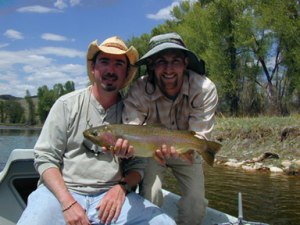 |
| Pheasant tails can bring out some nice trout |
One of my favorite variations, the Bead Head Soft Hackle P.T. works well in all types of water and lends itself to a variety of fishing techniques. In rivers, this particular pattern is one of my favorites and works well dead drifted with a slight rod lift and swing at the end of each drift. Many fish take the fly on the swing as it looks like an escaping insect. Another effective method is to fish this fly down and across much like the classic wet fly technique (make sure you throw a big upstream mend as this slows the fly down during the swing). When I'm guiding I'll often fish this fly as a dropper off of any dry fly pattern - this is especially effective during the beginning stages of a hatch. On lakes and ponds, this is a very effective fly (sizes 12-14) in the middle of the day during Callibaetis season. Use a floating line and retrieve the fly very slowly near the surface. Pay particular attention to shallow areas near weed beds. The B.H Softhackle Pheasant Tail is especially useful before, during, and immediately after a Callibaetis hatch.
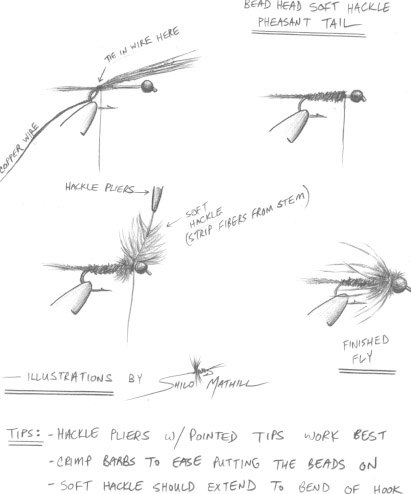
Below is the fly recipe and tying instructions for the softhackle variation. Remember; tie many sizes, colors, and variations. Have fun and fill your nymph boxes – you can never have too many and you will be pleasantly surprised when those selective trout see something just a little different and take a bite. Yum, Yum.
MATERIALS
- HOOK: Tiemco 200R - 3X long, semi-dropped point. Sizes 10-22 (any 3X nymph hook)
- HEAD: Copper bead
- THREAD: Brown, or color to match dyed pheasant tail
- TAIL: 3-8 fibers from the tail of a cock ring-neck pheasant (Sawyer recommends 4)
- RIB: Copper wire
- BODY: Fibers from center tail of cock ring-necked pheasant ribbed with copper wire
- THORAX: Syntilla Peacockle dubbing (#46)
- HACKLE: Natural or Olive Partridge
TYING INSTRUCTIONS
- 1. Slide a small brass bead onto the hook.
- Wrap tying thread just above the bend of the hook and tie in tips of tail feather fibers to form the tail of the fly. Fiber tips should extend one hook gap width past the bend. Do not trim butt ends of tail feather fibers, these will be used to form the body.
- Tie in a length of fine copper wire at the hook bend.
- Wrap pheasant tail fibers toward the eye of the hook, stop approx. 2/3 up the shank.
- Wrap the fine wire forward through body, tie off.
- Apply dubbing loosely to form thorax.
- Tie in soft hackle (butt end) and make and wrap one and a half turns, tie off hackle.
- Finish the fly by adding a slight amount of dubbing in front of the hackle and tying off. Note: You do not need to add dubbing for the smaller sizes, just tie off with thread.
 |