


Taylor Park Fishing
Submitted by Michele White (Murray), Tumbling Trout Outfitters
Gory Details: Two weekends ago, we joined Doug's family on their annual fishing trip in the vicinity of Taylor Reservoir. Unlike other Colorado watersheds, the Taylor Park watershed doesn't seem to be hurting for water. We stayed at Holt's Campground on Willow Creek, 7 miles below Tin Cup. We made great time over Cottonwood Pass, which is much improved over the last couple of years - not nearly so scary as when Mom used to clutch the armrest with closed eyes and us kids practiced saying Colorado words like, "timberline" and "tundra".
Doug's family members are all fishermen. The kids have their own tackle boxes and a couple rods by the time they're 5. Everyone catches fish: Grandma, ol' Uncle Ronny, aunties, teenage girl cousins with dyed hair and painted nails, goofy boys with big pants, They're BIG into fishing, the whole lot of them. However, when we arrived they were hanging out eating cherries by the pound (the western slope clan of Whites are orchard farmers). Doug joined their "White" dance, a slow ceremony executed with hands in pockets, teetering from one foot to another, milling about in pointless shuffles and smiling at each other's new dogs, new babies, new trucks. I don't know how to shuffle, so I put on waders and headed for the oxbows of Willow Creek next to the campground.
Access to Willow Creek is public from the reservoir up to Rainbow Village below Tin Cup, (about 5 miles). Infiltrating Willow Creek is extremely difficult due to the beaver canals and dense willows. I fought my way to the stream, which was flowing from bank to bank, (about 10-15 feet wide) and flanked by thickets of moose-food bushes taller than my head. The oxbow bends were tight. Every one of them scoured out deep pools then emptied onto long, straight riffles over smooth cobbles the size of Emu eggs.
I had a clue what dry fly pattern to use, considering caddis came off the bushes like fairy dust. I caught Brookies in the riffles, the pools, and under overhanging bank. Most of the fish were over 10". One was 15". The bigger fish definitely preferred faster water. Later, I learned from the owner of Holt's that a 6 Lb. Brook trout had been taken from that creek.
I fished for an hour steadily moving upstream using short, fast casts so as to avoid getting tangled in the dense bushery on my back cast. The wind was strong at my back, so the line sailed upstream nicely if I cast low. I stopped counting fish at 20 and figured I must have caught twice that before I ended my expedition at the bridge. I noticed that fish got pickier and smaller as I approached the bridge, which an easy, frequently accessed point to enter Willow Creek about 2 miles above the turn-off at Taylor Park Trading Post.
There're a couple fly fishermen in the White Family, but for the most part, they know how to catch a fish using traditional baited methods. Late into the first night's campfire stories, the elder Uncle Ronny asked me what I had been using to catch fish in Willow Creek. I told him about caddis -- what they looked like and how they operated. In the morning, he asked me again. I showed him my caddis and gave him a few of the patterns. I also gave him a reel of #5 tippet and suggested he use his spinning rod to cast this fine tippet below a clear bubble-bobber with a caddis dry fly.
We loaded canoes on our vehicles and headed to Mirror Lake, the headwaters of East Willow Creek. People are friendly up there. The residents of Tin Cup seem like they might be keeping an eye on you at first, (can't blame them since all the tourists in the world drive by their front yards to visit some of the prettiest country in this state), but mostly, they're just friendly. We know this, because we didn't realize we had lost a canoe on the bumpity road up to Mirror Lake and scattered belongings for 3 miles. A nice lady caught up with us on a dirt bike and pulled us over. "Hey! You lost everything WAY back there!" We backtracked down the mountain and encountered a chain of do-gooders carrying our stuff and making piles of our possessions along the road. We weren't missing a thing.
Mirror Lake is one of those Rocky Mountain scenes you really need to make yourself get out and see. Obvious from its name, Mirror Lake is a lovely, deep lake that reflects the steep sides of a densely forested, glacially sculpted bowl. Jagged peaks of darkly banded, metamorphic rock tower overhead with snow still on them, though it is summer.
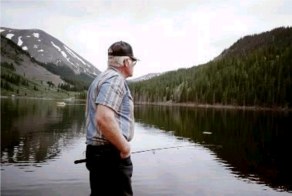
Uncle Ronny inspecting a rise on Mirror Lake
There is a hidden campground up there and a small parking place for day use. Plus, it's only 10 miles from the reservoir (7 miles to Tin Cup, then another 3 from there). The lake is stocked with Rainbows, but the population of Brookies seems to far outnumber them.
There's something about Brookies I should mention: they are not trout. They are ocean-going Char, thriving inter-continental now, like alien imposters. A long time ago they lived in extremely cold water of the Arctic and North Atlantic Oceans. When they adapted to fresh water, they spread across the North American continent like fire. Brookies are so adaptable to a variety of habitats that they commonly overpopulate themselves and compete with trout for survival, to the point of replacing the trout and even starving themselves out of a habitat. Consequently, the Colorado Division of Wildlife allows a daily bag limit of 10 Brookies (8" or less), in contrast to 2 river-dwelling or 4-lake dwelling trout (release of true-trout is encouraged).
That day on Mirror Lake, it was all systems go for the Whites! Those of us in canoes caught Brookies and Rainbows on caddis. The Whites along the bank did too. Uncle Ronny caught 50 Brookies using caddis with his spinning rod and released most of them. Grandma caught 2 Rainbows using worms and kept them for her dinner. We fished all day, loitered about canoes, took hikes, too. That night we made Brook Trout fajitas for dinner.
Next day would be half-day fishing since a lot of Whites needed to head for home. We settled on the southeast shore of Taylor Reservoir, just below the mouth of the Willow at lunchtime. I'm not a big fan of lake fishing, unless it's a small lake and I'm in a canoe. This was going to be one of those lawn-chair scenarios along the bank. Instead, I waded into the shallow lip of the lake away from the family and cast toward the inlet with a large mayfly pattern after Doug pointed out the existence of Green Drakes to me.
There were other fly-fishermen at the inlet casting out toward the lake. I didn't see any action there. After they moved off, I replaced the mayfly with a caddis and cast upstream into the riffles of Willow Creek. BOOM! An amazing Rainbow of 22" took my fly out into the deeper lake like a pit bull terrier on a snorkel. I only had a small, 15" net hanging from my neck intended for wrangling Brookies, so I had to hang on. This Rainbow bent my little 7.5' #4 weight rod in half. I let him run back and forth along the shoreline but kept my tip up, so as not to lose him.
I reeled the fat boy back upstream and let him run in his maddening dash back to the lake a couple more times, so as to tire him a bit. My intention was to pull him toward me and release him underwater. After 3 tries, I accidentally dropped my rod and got my line tangled with my sandals.
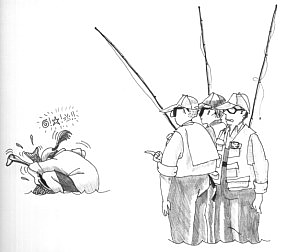
I knew I had to try to net the trout with my pathetic little net. Basically, I stuck the net on his head and trapped him between my legs so I could loose the barbless hook (Karen Christopherson, editor of this Website, once humored me to manufacture a rubber trout for practicing catch & release). By the time I accomplished the release, (and let go a couple bad words), the big Rainbow lay prone in my hands, disoriented. I held him topside up in the water for a moment, facing the lake. He leapt out of my hands and made his way clear to the other side of Taylor Reservoir, I'm sure.
I had to dig my fingers into the soft mud to find my rod. When I stood up, I saw a group of well-dressed fly fishing gentlemen peering at me from behind, like a Trout Unlimited judgment committee at a tournament. "Nice Fish". "Thanks", I said, trying to look as if I deliberately stomped my rod and reel into the mud.
Doug joined me with his little brother and we fished our way upstream using caddis dry flies. We experienced the same situation I had before, in that the closer we got to an easy access (a bridge, a footpath, etc.) the fish got smaller and harder to catch. We saw big fish, mostly in a scurry to get away from our thirsty dogs that had joined us.
All in all, fishing was ON all weekend - and we didn't even get a chance to try the tail-waters where great hogs of Rainbows are known to feed selectively on shrimp! We'll just have to return another time.
Post Script: Aunt Myrna caught 2 Rainbows and 2 Cutthroat trout off the shoreline that were uniformly 22" and of the same girth - apparently a phenomenon of growth restricted by the size of habitat. Also, one of her Cutthroats had peculiar lacerations that we suspected were propeller marks until Doug examined them and told us they were Lake Trout bites! Hey! Get out of the water!
All text and graphics Copyright © 2001 by Michele White (Murray), Tumbling Trout Outfitters. No reproduction, linking, or copying without permission